
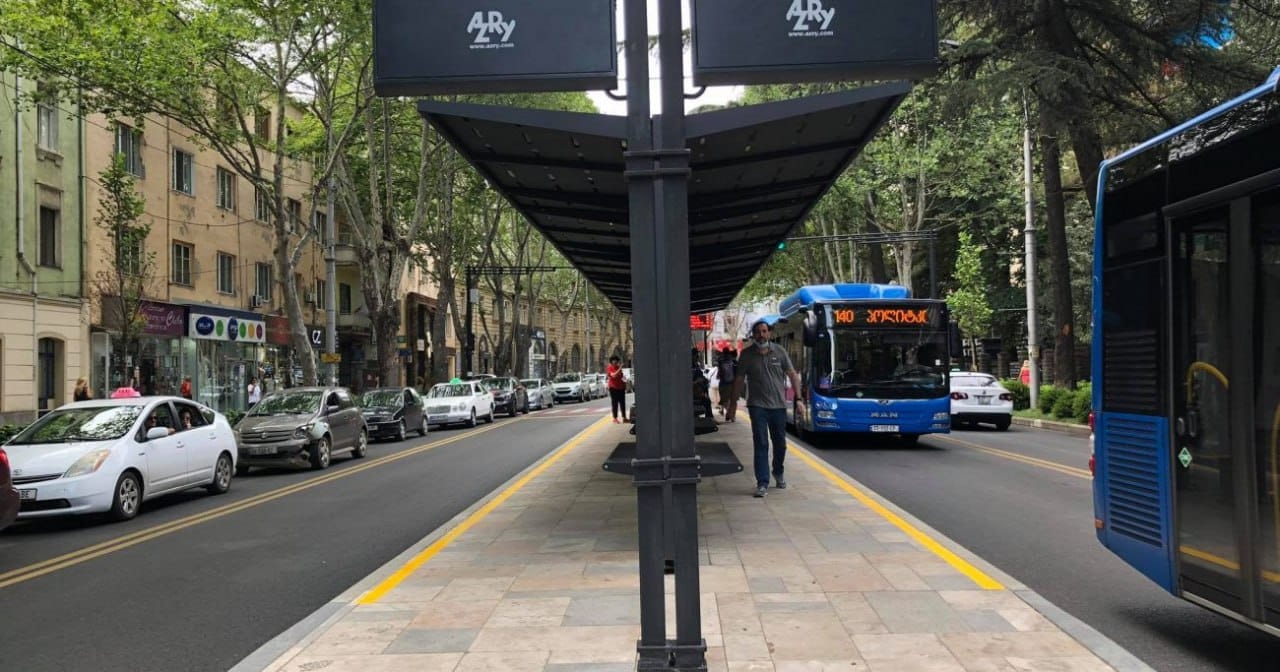
Tbilisi, Georgia, I. Chavchavadze Avenue (A / MZ A-20 with Veleton MPC)
In 2021 a project began to restore I. Chavchavadze Avenue in Tbilisi. Under the design, stone mastic asphalt SMA-20 with a modified binder was used for the upper courses of the pavement.
Despite the use of SMA and modified bitumen, signs of rutting began to show on the bus lanes within a few months of the works being completed. This indicated that the solution applied was not providing sufficient resistance of the pavement to the actual service loads.
During the year the asphalt pavement on the problem sections was replaced twice, but the problem could not be resolved. Rutting continued to appear precisely in the most intensively loaded zones, on the bus lanes and the braking sections.
The main causes of the accelerated breakdown of the pavement were:
High urban traffic
Round-the-clock traffic of buses weighing from 16 tonnes
Intensive shear loads in the surface course of the pavement
Frequent braking and acceleration of public transport
Increased pressure on the pavement along the same wheel paths
Insufficient resistance of the previous solution to plastic deformation
The need for annual and repeated routine repairs
The team's task was to move away from constant repairs, to select a more resistant type of asphalt mixture and to provide a pavement able to work under intensive bus loads without rutting.
The production side of the project was a further challenge. The supplier of ready-made modified bitumen had interruptions to deliveries, so the asphalt plant had to move to modifying on its own with limited technical capability.
Modification of the asphalt mixture using the Veleton MPC polymer-composite modifier by dry addition was chosen to solve the problem.
The key decision was to change the type of pavement: instead of SMA-20 with a modified binder, type A / MZ A-20 asphalt with Veleton MPC was used on the bus lanes.
This approach made it possible not merely to replace the material but to adapt the design solution to the site's actual service conditions: high traffic, regular movement of heavy buses, braking zones and intensive shear deformation.
Three key changes were made in the project:
Changing the type of asphalt mixture from SMA-20 to type A / MZ A-20 asphalt
Using Veleton MPC by dry addition
Adapting the dosage to the most heavily loaded sections of the bus lanes
Dry addition proved the optimal solution for the asphalt plant, since it made it possible to move quickly to modifying the mixture on its own, without depending on deliveries of ready-made modified bitumen.
Veleton's technology made it possible to:
Increase the resistance of the pavement to rutting
Reduce the risk of plastic deformation in braking zones
Increase the resistance of the pavement to shear loads
Adapt the properties of the mixture to the bus lanes
Do away with constant dependence on ready-made modified bitumen
Give the asphalt plant flexibility in production
Reduce bitumen costs
Reduce the need for repeat repairs
The Tbilisi project was carried out as a rapid deployment of the technology at a working asphalt plant.
Veleton specialists provided comprehensive support for the move to modifying on site:
Audited the asphalt plant's equipment
Assessed the technical capability of production
Identified the plant's limitations
Selected Veleton MPC for the task of rapid in-house modification
Adapted the dry addition technology to the existing equipment
Gave recommendations on the production process
Helped start modification without purchasing ready-made modified bitumen
Selected a dosing approach for the most heavily loaded sections
Supported the plant's move to working permanently with Veleton MPC
The speed of deployment was a separately important factor. The plant needed to resolve the interruptions to modified bitumen deliveries promptly and to keep road works going without stopping production.
A month after deployment the asphalt plant gave up ready-made modified bitumen entirely and moved to permanent in-house modification using Veleton MPC.
The project produced a result both at the level of the pavement and at the level of the economics of production.
Project timeline
2021, major repair of I. Chavchavadze Avenue completed, the design solution being SMA-20 with a modified binder
A few months later, signs of rutting appearing on the bus lanes
During the year, the pavement on the problem sections replaced twice
2022, type A / MZ A-20 asphalt with Veleton MPC laid on the bus lanes
2026, no rutting or other defects on the sections with Veleton MPC
Service figures
Bus traffic: round the clock
Bus weight: from 16 tonnes
Most problematic zones: bus lanes and braking sections
Condition of the pavement as of 2026: no rutting and no visible defects
Repeat repairs after the solution was applied: not required
Production figures
Time for the asphalt plant to move to in-house modification: around 1 month
Giving up ready-made modified bitumen: complete
Reduction in bitumen costs: 14%
Stability of the asphalt plant's work: increased
The main practical result is that a section which previously needed the pavement replaced again within its first year of service now works, after Veleton MPC was applied, with no rutting appearing at all, even under round-the-clock traffic of buses weighing from 16 tonnes.
As of 2026 no rutting is observed on the bus lanes of I. Chavchavadze Avenue, there is no cracking or shear deformation, and the pavement remains in stable condition with no need for repeat repairs. It matters particularly that the result was achieved on sections where the previous solution, SMA-20 with a modified binder, did not provide the resistance required. This confirms that for heavily loaded bus lanes what is decisive is not only the presence of a modified binder but also the right choice of mixture type, asphalt structure and method of modification.
The economic effect showed at two levels. At the level of production, the asphalt plant stopped buying ready-made modified bitumen and moved to modifying on its own, cutting bitumen costs by 14% and reducing its dependence on an external supplier. At the level of road maintenance, annual routine repairs were eliminated, repeat replacements of the pavement were reduced to a minimum, and the service life between repairs was increased many times over, which considerably reduced budget costs on a problem section. The saving was achieved not by making the material cheaper but by a more precise engineering solution: changing the type of mixture, using Veleton MPC and moving to controlled in-house modification.
“After several unsuccessful attempts to solve the rutting problem on the bus lanes, we were looking for a solution that would genuinely stand up to the real loads. Using Veleton MPC allowed us not only to stabilise the pavement but also to do away with constant repairs. Today the section works with no defects, and that is the best measure of how effective the chosen solution is.”
- Type
- Heavily loaded urban arterial road with bus lanes and zones of intensive braking
- Problem
- After the 2021 major repair with SMA-20, rutting appeared on the bus lanes twice a year; the pavement was replaced, but the problem could not be resolved
- Solutions / technology
- Veleton MPC, dry addition into type A / MZ A-20 asphalt
- Type of mixture
- Originally SMA-20 with modified binder; finally A / MZ A-20 with Veleton MPC
- Result with Veleton
- As of 2026 no rutting is observed, there are no pavement defects, and repeat repairs are not required
- Service load
- Round-the-clock traffic of buses weighing from 16 tonnes
- Production effect
- Within a month the asphalt plant gave up ready-made modified bitumen entirely and moved to modifying on its own
- Effect on the budget
- Bitumen costs fell by 14%; annual repairs were eliminated and budget costs considerably reduced
4 fotos