
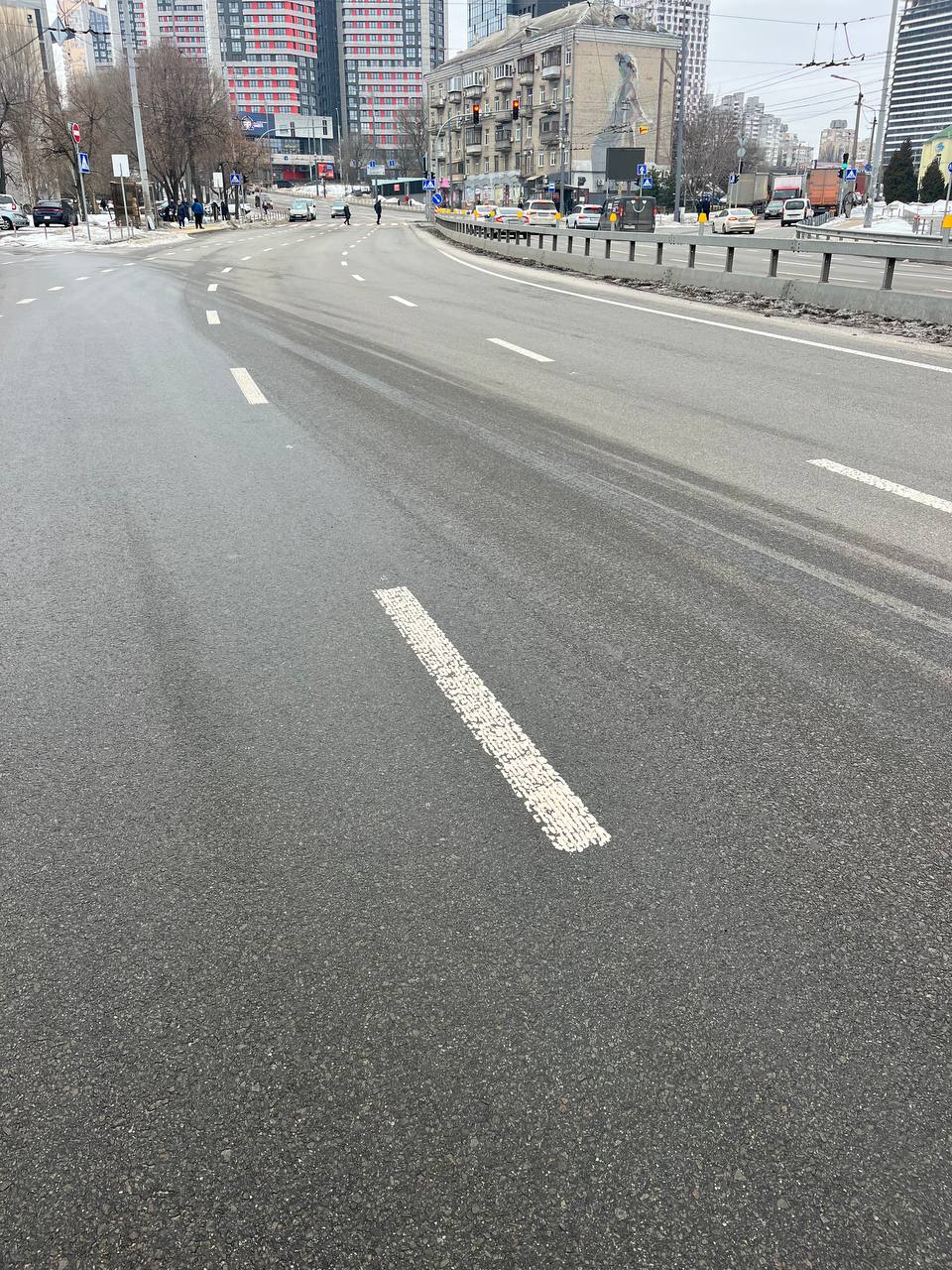
Kyiv, Ukraine, Vozdukhoflotsky Avenue and Vasiliya Lipkovskogo Street (A-40 and A-20 asphalt mixture with Veleton MPC)
The pavement at a number of urban sites in Kyiv was in poor condition. Rutting was observed on Vozdukhoflotsky Avenue, there were potholes under the bridge on Vasiliya Lipkovskogo Street, and a large number of cracks were recorded on individual sections of the avenues.
The main factors in the breakdown of the pavement were:
High traffic loads
Intensive urban transport traffic
An uneven longitudinal and transverse road profile
Braking zones ahead of traffic lights
Increased stresses in the pavement on sections under bridges and where the road geometry changes
Service of the pavement under frequent temperature swings
The team's task was not simply to restore the surface course but to increase the durability of the whole road structure on the most heavily loaded sections. To do that it was important to modify not only the A-20 surface course but also the coarse-grained A-40 lower course, which takes a significant part of the service loads.
The period of production and paving was a further technological challenge. The works were carried out in autumn, when the ambient temperature reduces the time available for haulage, paving and compaction of the asphalt mixture.
Combined modification of the asphalt mixture using Veleton MPC and an energy-saving additive was chosen to solve the problem.
The key difference in this project was that not only the surface course was modified but the coarse-grained lower course as well. This approach matters particularly for urban arterial roads carrying high loads, where premature deformation often forms not only in the surface course but in the lower part of the asphalt structure.
The following were used at the site:
A-40 asphalt mixture, the coarse-grained lower course
A-20 asphalt mixture, the surface course
Veleton MPC at dosages of 2.5 kg/t and 2.0 kg/t
An energy-saving additive to keep the mixture workable in autumn
Dry addition of Veleton MPC made it possible to:
Modify the mixture directly during production
Increase the resistance of the pavement to rutting
Improve how the pavement performs on sections with intensive braking and acceleration of traffic
Increase the crack resistance of the pavement
Keep the mixture workable over long haulage
Make paving possible even after prolonged haulage
Increase the reliability of both the surface and the lower course of the road structure
The use of an energy-saving additive was a separately important factor. It made it possible to keep the working properties of the mixture in autumn production and over the long interval between discharge at the asphalt plant and paving at the site.
The Veleton team provided technical support for the project at the production and paving stages and for the subsequent audit of the pavement's condition.
The support covered:
Control of the Veleton MPC dosage
Control of the dry addition technology
Control of the mixing time before the bitumen is fed in
Support of mixture production at the Zorya / Kirlite asphalt plant
Advice on using the energy-saving additive in autumn
Control of the mixture temperature at loading
Control of the mixture temperature during paving
Assessment of the workability of the mixture after prolonged haulage
Visual audit of the pavement's condition after several years in service
Comparative assessment of the sections against the audit in autumn 2025
Production process regime
Mixing Veleton MPC with the mineral fraction before the bitumen is fed in, 15 seconds
Temperature of the asphalt mixture when loaded into the truck, 175 °C
Temperature of the asphalt mixture during paving, 165 °C
Time from discharge of the mixture to the moment of paving, around 5 hours
Despite the long haulage time, the mixture kept its working temperature and workability. This was made possible by the combined use of Veleton MPC and an energy-saving additive.
The project confirmed the effectiveness of combined modification of asphalt mixture for urban arterial roads carrying high traffic loads.
Key process parameters
Asphalt plant: Zorya
Lower course: coarse-grained A-40 asphalt mixture
Surface course: A-20 asphalt mixture
Veleton MPC dosage: 2.5 kg/t and 2.0 kg/t
Mixing before the bitumen is fed in: 15 seconds
Temperature at loading: 175 °C
Temperature during paving: 165 °C
Time from discharge to paving: around 5 hours
The key practical result is that the mixture kept the temperature and workability it needed even after long haulage. This matters particularly for urban sites, where paving often depends on traffic, movement restrictions, weather conditions and organisational pauses.
After the project was completed, several audits of the pavement's condition were carried out on Vasiliya Lipkovskogo Street and Vozdukhoflotsky Avenue.
Vasiliya Lipkovskogo Street, upper section (around 3 years in service)
The main carriageway with no issues
No cracking
No rutting
No pronounced deformation
Vasiliya Lipkovskogo Street, section under the bridge (around 5 years in service)
No cracking
No rutting
No potholing
No issues found with the condition of the pavement
No change recorded against the audit in autumn 2025
A section under a bridge is traditionally among the problem zones because of increased humidity, temperature swings, limited ventilation and local loads. The absence of cracking and rutting after 5 years in service confirms the effectiveness of the modification.
Vozdukhoflotsky Avenue (around 5 years in service, major repair)
No cracking
No rutting
Local deformation is visible on the braking sections ahead of the traffic lights
A fully formed rut is still a very long way off
No change found against the audit in autumn 2025
The use of an energy-saving additive was a further factor in the effectiveness: it kept the mixture workable in autumn and made paving possible even with around 5 hours between discharge and paving. The main conclusion of the project is that for the most heavily loaded urban sections it is important to modify not only the surface course but also the coarse-grained lower course: it is this approach that increases the resistance of the whole road structure, rather than simply improving the properties of the finishing course. Using Veleton MPC in A-40 and A-20 asphalt mixture produced a pavement that after 5 years in service remains in excellent condition, with no cracking, rutting or significant deformation, and the absence of any change between the audit in autumn 2025 and the repeat audit in 2026 confirms the stability of the pavement and the low rate at which service defects accumulate.
“Using Veleton MPC together with an energy-saving additive gave us a stable result even under difficult urban service conditions. The pavement shows high resistance to loads and keeps its properties over several years with no significant change.”
- Type
- Combined modification of the lower and the surface course on heavily loaded urban sections
- Problem
- Rutting, potholes, cracking and deformation on sections with high traffic loads, a difficult road profile and intensive braking
- Solutions / technology
- Veleton MPC, 2.5 and 2.0 kg/t, dry addition + energy-saving additive
- Type of mixture
- A-40 asphalt mixture, coarse-grained lower course; A-20 asphalt mixture, surface course
- Process parameters
- Mixing 15 seconds; loading 175 °C; paving 165 °C; around 5 hours before paving
- Result with Veleton
- The pavement has stayed in excellent condition after 5 years in service
- Condition after the audit
- No cracking or rutting; local deformation is visible only in the braking zone ahead of the traffic lights on Vozdukhoflotsky Avenue
- Additional effect
- The energy-saving additive kept the mixture workable in autumn with around 5 hours before paving
8 fotos