
Improving the in-service performance of asphalt pavement on roads and on the bridges of the transport infrastructure, through the “dry-add” method of polymer modification.
Introduction
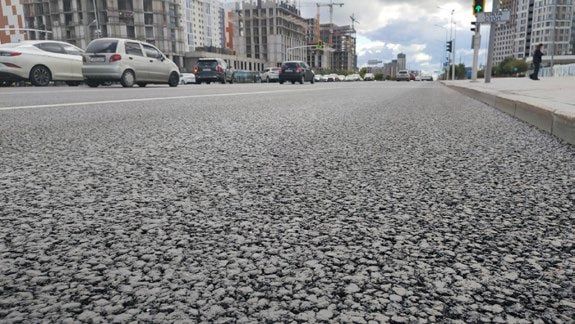
In recent years the quality of materials and of pavement construction works in the countries of Europe, Asia, the CIS, America and Africa has improved significantly. This is due to a large extent to the introduction of new technologies and standards and to the use of modern construction materials that deliver durability and reliability of the pavement. However, given climate change and the growing intensity of traffic loading, the question of securing the stability and the temperature resistance of asphalt pavements is becoming ever more pressing.
The problems associated with the physical and chemical properties of the bitumens used as the binding element in asphalt mixtures call for deeper research and for new technological approaches. Modifying bitumen with polymers and other additives can significantly raise the resistance of asphalt pavement to external effects such as temperature swings, the action of moisture and mechanical loading. This question has been raised repeatedly in various scientific publications, such as “Bitumen and Bitumen Modification: A Review on Latest Advances” (Applied Sciences) and “Исследование особенностей взаимодействия битумов с полимерами” (D. A. Ayupov, L. I. Potapova) and many others. However, as scientific research shows, the particular character of bitumens produced by distillation either considerably complicates their modification or makes it practically impossible. The inconstancy of bitumen indicators and their divergence from the declared characteristics likewise call for a search for alternative solutions to obtain a quality asphalt pavement.
The aim of the work
The aim of this work is to draw the attention of experts and specialists in the road construction industry to an alternative technology for modifying asphalt mixtures, one that makes it possible to reach stable in-service characteristics of the pavement irrespective of the instability of the properties of the original bitumen. Particular attention is given to the use of polymer additives capable of compensating for the shortcomings of modern bitumens, especially those obtained by the distillation method, and in particular for their low capacity to be modified with polymers. This technology is intended to secure the stability and the length of service of road pavements under significant temperature swings and increased loading from traffic.
The research is directed at finding an optimal polymer modification process, one that will deliver the necessary physical and mechanical characteristics of asphalt concrete, wear resistance and a long service life of the pavement structure. Beyond that, a principal aim is to simplify the modification process and to reduce the costs of producing quality pavements.
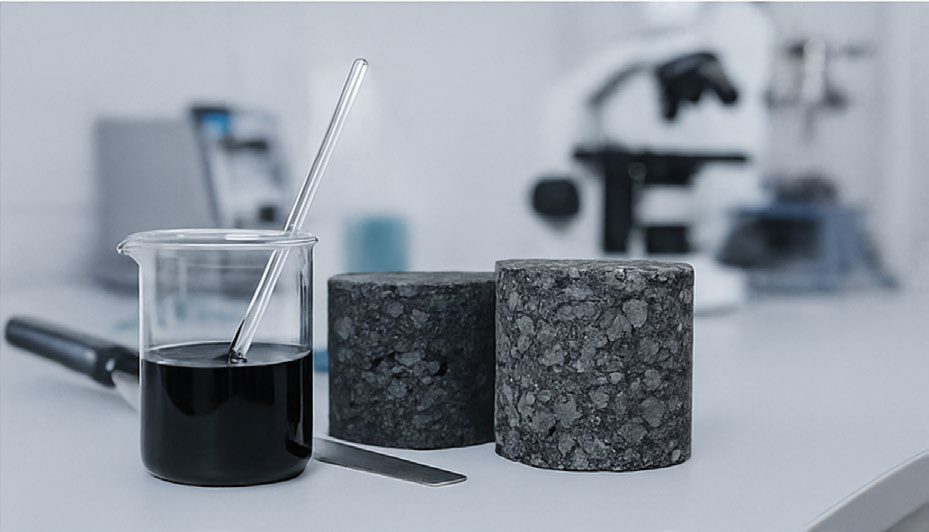
The active development of the road construction industry in developing and developed countries alike, and the growing volume of road building, calls for a significant improvement in the quality of the materials used in laying asphalt pavements. Among the main components that determine the durability of the pavement, the asphalt mixture plays no small part. It has to withstand not only the dynamic loading from traffic but also to show resistance to sharp changes of temperature, to the effect of precipitation and to other aggressive factors of the external environment.
The key element determining the properties of asphalt mixtures is bitumen, which performs the function of the binding material, providing adhesion between the particles of the mineral components. However, as scientific research in this field has deepened, it has been found that the quality of the original bitumen does not always meet the necessary standards. This follows not only from the characteristics of the raw material itself but from the particulars of its production, especially where bitumens obtained by distillation at oil refineries are used.
As a colloidal system, bitumen consists of a variety of chemical compounds which have particular properties and form its structure. Depending on the quantitative ratio of these components, bitumen can have a different physical structure. The most widely accepted model of bitumen describes it as a colloidal solution in which large molecular structures (micelles) are linked to one another by weak hydrogen bonds. The micelles are formed from asphaltene molecules, which are the hardest part of the bitumen, while their outer surface is stabilised by resins. This provides the structural stability of the bitumen in the colloidal phase.
On the basis of this model, three main structural types of bitumen are distinguished: “sol”, “sol-gel” and “gel”. Each of these types has its own particular physical and chemical characteristics. For example, bitumens of the “sol” type are characterised by a high asphaltene content, which makes the structure of the bitumen more rigid and brittle. Bitumens of the “gel” structure, by contrast, have a thinner consistency, since they have a high content of oils and resins. The most suitable for use in producing polymer-modified bitumen (PMB) are bitumens of the “sol-gel” type, since they combine the best properties of both types and have balanced physical and mechanical characteristics.
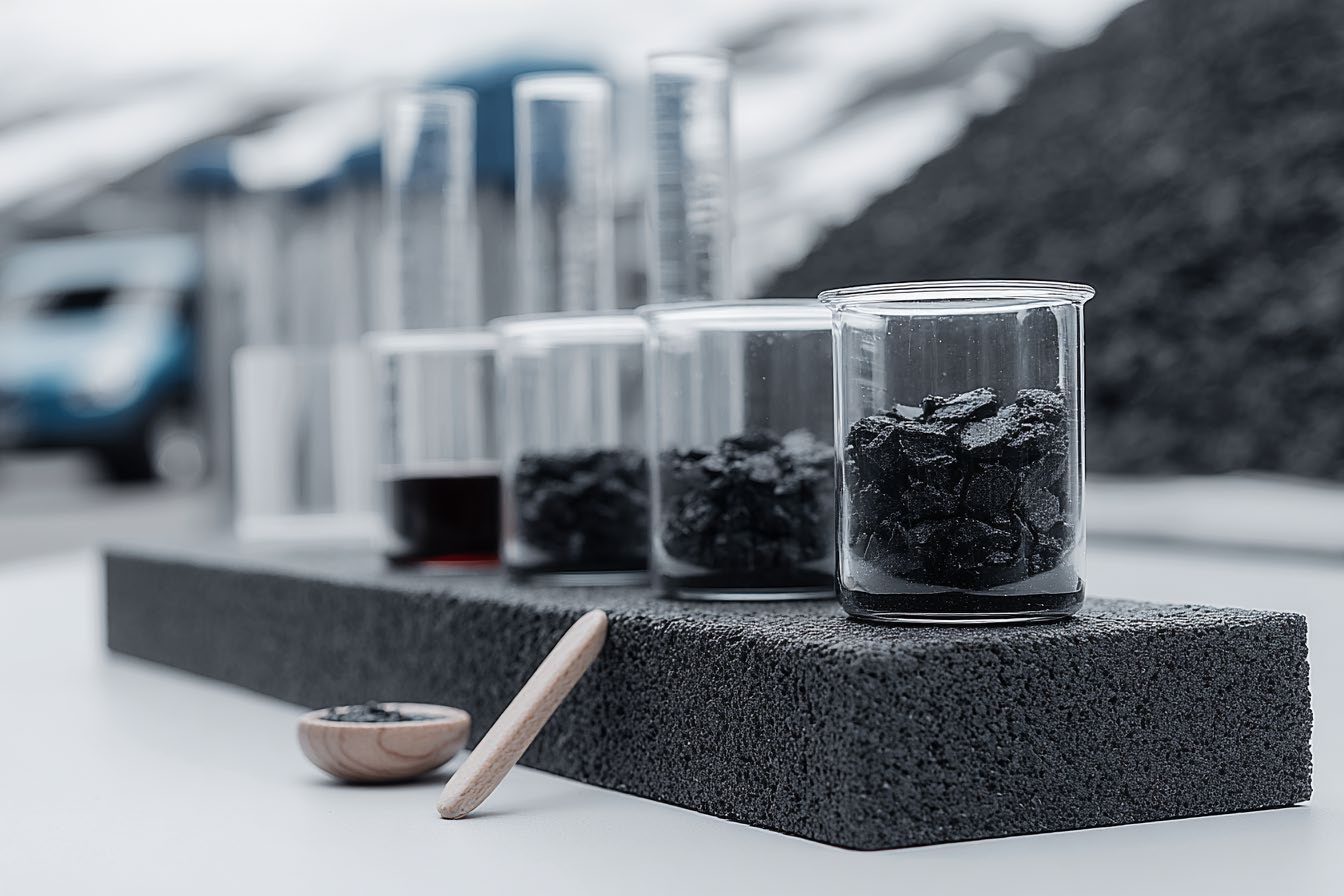
Despite this, the process of modifying bitumens with polymers often runs into a number of difficulties. One of the main problems is the competition between the asphaltenes and the polymers for the maltene fraction of the bitumen, which is the principal dispersion medium of the modification. During this process the polymers introduced into the bitumen have to acquire a stable dispersed phase in a medium already occupied by asphaltene molecules. This significantly complicates the swelling of the polymer and reduces the effectiveness of the modification. It shows itself particularly in the case of bitumens obtained by the distillation method, which have a lower asphaltene content, and this makes them less suited to modification.
For bitumens to be successfully modified with polymers, the original bitumen has to have optimal properties. In particular it matters, by way of example, that the needle penetration depth at a temperature of 25 °C should be between 60 and 90 mm⁻¹ for the climate of Eastern Europe. However, the realities of the oil refining industry force producers to extract the light fractions of the oil to the maximum, leaving bitumen as a residual product, which often leads to a deterioration in its quality.
Oil refining technologies are constantly being improved, making it possible to extract to the maximum from the raw material the valuable light petroleum products — petrol, diesel fuel, aviation kerosene — which are far more costly than bitumen. Modern methods such as deep refining, hydrocracking and thermal cracking increase the yield of motor fuels considerably. A side effect of this process, however, is a deterioration in the quality of the bitumen, since it remains a residual product with altered structural characteristics.
Formerly bitumen was obtained predominantly by straight-run distillation, which gave it a balanced composition and stable in-service properties. Today destructive processes prevail in production, in which the most valuable components are removed from the oil, and the bitumen that remains is characterised by a low content of high-molecular compounds, an unstable structure and an increased tendency to age. Beyond that, oil refineries increasingly use raw material with a high paraffin content, which further reduces the elasticity of the bitumen and worsens its adhesive properties. Bitumens obtained by the distillation method without subsequent oxidation are particularly problematic. They interact poorly with polymers such as SBS, since they contain an insufficient quantity of the asphaltenes needed to form a stable network structure. As a result, polymer modification calls for additional plasticisers and stabilisers, an increased consumption of polymers, or combined and expensive solutions in order to reach the required in-service characteristics. In substance this makes the modification of bitumen extremely complicated and economically unjustified, since the financial outlay and the technical risks are not covered by the possible result.
In these conditions road authorities and producers of asphalt mixtures are obliged to look for effective additives and technologies that compensate for the shortcomings of modern bitumen and secure the durability of the pavement.
The market and the results of the research
In recent years demand for road bitumen in the countries of Europe, the CIS and Central Asia has grown significantly, especially in connection with the delivery of large-scale infrastructure projects such as the building of new roads and the reconstruction of existing transport arteries. If in 2017 the total requirement of the road industry for bitumens in one country alone – Ukraine – was around 350-400 thousand tonnes a year, then by 2021 this figure had grown to 1.2-1.4 million tonnes. The growth in demand for bitumen led to active imports of distillation bitumens from the countries of Southern Europe and Asia. These bitumens, however, often have properties that differ significantly from the requirements of the standards, especially during modification with polymers.
Over the course of 2021-2024 a group of competent experts carried out more than 90 tests of various samples of bitumen produced in Italy, Spain, Greece, Poland, Azerbaijan, Iran and other countries. The generalised results of this research revealed serious problems with the correspondence of the declared characteristics of the bitumen to the actual indicators, in particular for the softening point and the penetration. Moreover, no clear dependence was established between the initial characteristics of the bitumen and the results of the modification. Importantly, some samples did not undergo modification at all, even when the quantity of polymer and the time of the modification process were increased. Beyond that, the finished asphalt mixture sometimes showed unpredictable physical and mechanical properties, which called for constant correction of the modification process.
A further problem arising in the production of polymer-modified bitumen is the separation of the bitumen during storage and transport. This leads to a situation where, when the bitumen is used for laying the pavement, its properties may differ significantly from the original ones, which tells negatively on the quality of the asphalt mixture. Worst of all, staff at asphalt plants and laboratories very often have to take difficult decisions quickly, without having enough time for tests and laboratory trials.
An alternative to modifying the bitumen is the technology of modifying the asphalt mixture, as the end product, by the “dry-add” method, with a polymer additive such as “MPC” VELETON™ added directly into the asphalt mixer, which meets the requirements of ДСТУ 8959-2019, ГОСТ Р 58406.2-2020, СТ РК 2373-2019 and others.
This technology has long been established and is actively used by the road construction industry of the leading countries of Europe and Asia, and of the USA as well, and has certain advantages over conventional bitumen modification, namely:
- The quality and the physical and mechanical properties of the end product – the asphalt mixture – do not depend significantly on the quality of the bitumen or on its capacity to be modified with polymers. The reason is that a “dry-add” polymer additive works with the components of the mixture, specifically with the coarse aggregate, so the asphalt mixture gains strong polymer bonds between its components, which can be pictured as a 3D polymer lattice.
- The process of producing the asphalt mixture is significantly simplified, because no complex and costly equipment for polymer modification of bitumen is required, such as a colloid mill and high-speed mixers. The producer also saves a significant amount of time, because the bitumen can be used immediately, without the usual 8-12 hours of modification (as with additives of the SBS type).
- There is no need to heat the bitumen significantly (above temperatures of 165-170 °C), which does not lead to its rapid oxidation and ageing.
- Results from using the “dry-add” MPC additive are always predictable and calculated mathematically, depending on the type of asphalt mixture and the amount of polymer in it.
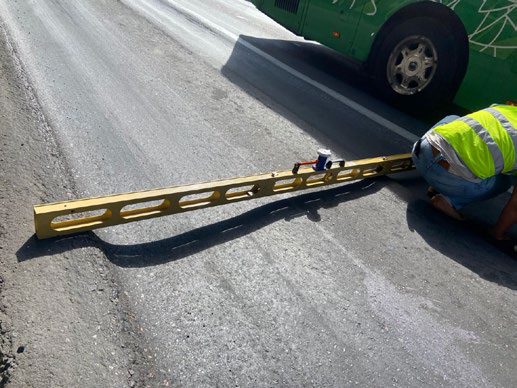
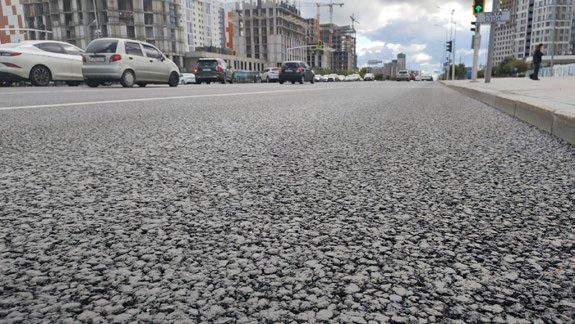
Table 1 — analysis of the use of the “dry-add” additive on the example of Ukraine in the period 2020-2024 shows the following results:
| № | Indicator | Asphalt mixture without polymer | Additive dosage 2.2 kg per tonne of mixture | Additive dosage 2.5 kg per tonne of mixture |
|---|---|---|---|---|
| 1 | Compressive strength R20 | 2.6 MPa | 5.2 MPa | 6.1 MPa |
| 2 | Compressive strength R50 | 1.24 MPa | 2.05 MPa | 2.4 MPa |
| 3 | Rut depth over 20,000 passes, Hamburg wheel method | 7.5-8 mm | 2-2.5 mm | 1.2-1.5 mm |
Table 2 — results of the comparison of experimental and theoretical data, determination of the number of load cycles to failure of the studied asphalt concrete samples with the additive. Temperature: T = +20 °C.
| № | Asphalt concrete designation | Number of cycles to failure Nт (theoretical) | Number of cycles to failure N (experimental) | Δ, % |
|---|---|---|---|---|
| 1 | B-20-6.0% | 413 | 478 | 13.7 |
| 2 | Additive dosage 2.2 kg/tonne of mixture | 3843 | 4438 | 15.4 |
| 3 | Additive dosage 2.5 kg/tonne of mixture | 6379 | 7368 | 15.5 |
The data obtained (Table 2) indicate that the theoretical calculations agree with the experimental data. This shows that these dependencies can be used in practical calculations in order to secure or to forecast the durability of asphalt pavement on roads and on bridges under the effect of temperature and of the loading from vehicles, and also to forecast its changes during service over a given period of time.
Experience of use by leading road construction companies in the countries of Europe, the CIS and Central Asia has shown high and, most importantly, repeatable results, high resistance to loading, frost resistance and shear resistance of asphalt pavements. The test results show that the asphalt mixture meets the requirements of ДСТУ 8959-2019, ГОСТ Р 58406.2-2020, СТ РК 2373-2019 and others on every indicator.