
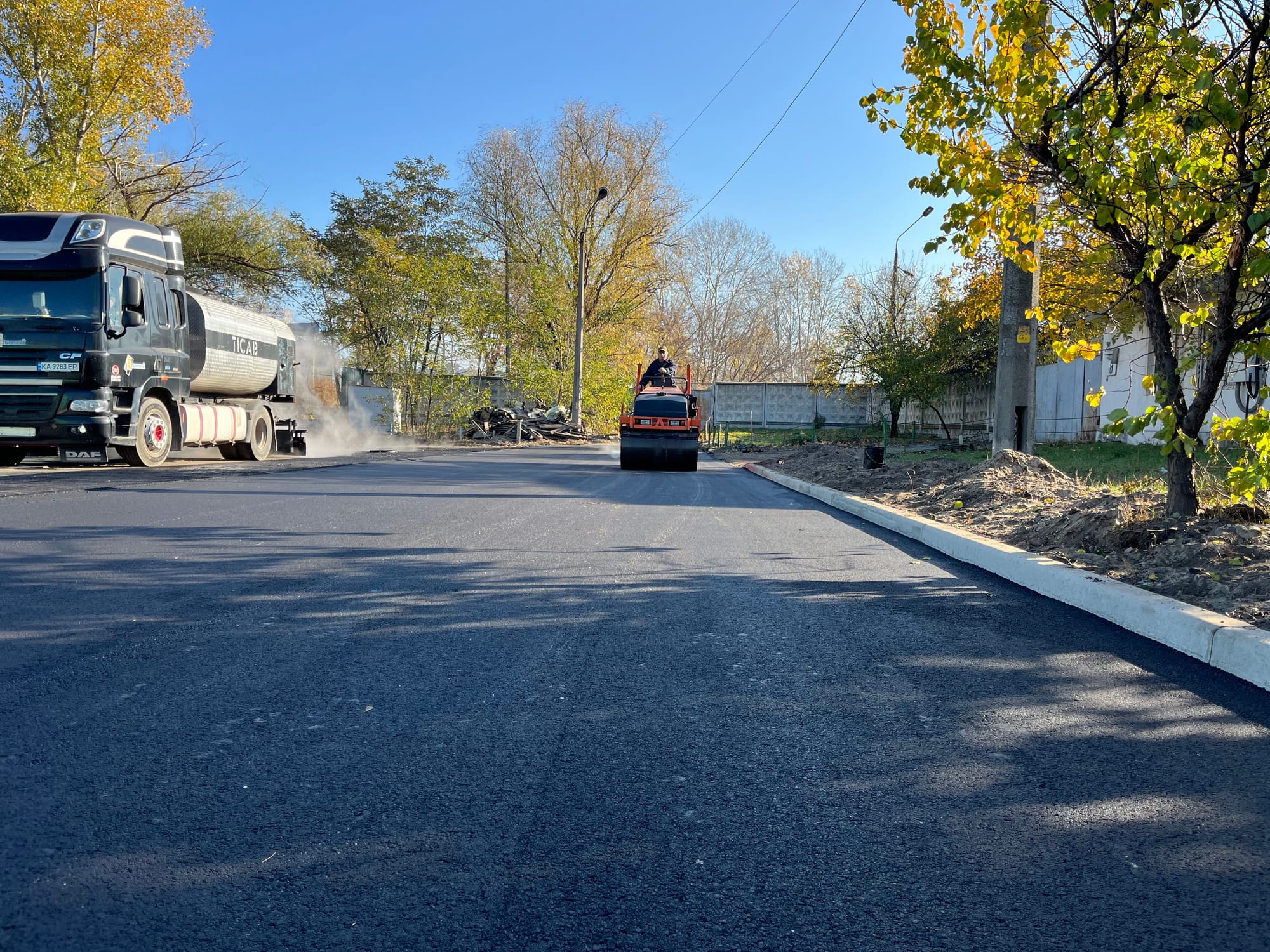
Kyiv, Ukraine, Verbovaya Street (autumn paving with liquid Veleton ESA)
On Verbovaya Street in Kyiv the works were carried out in autumn at an air temperature of +8 °C. Under such conditions contractors normally raise the discharge temperature of the mixture to at least 170 °C in order to keep it workable and to achieve good compaction.
The task was to achieve paving and compaction without overheating the mixture and without unnecessary energy costs.
Liquid Veleton ESA was used at a dosage of 1%. The additive made it possible to keep the mixture workable at the reduced temperature, to achieve good compaction, to lower the discharge temperature and to cut fuel consumption at the asphalt plant.
Veleton specialists provided control of the use of liquid Veleton ESA, discharge of the mixture at 140 °C, control of the paving temperature at 120 °C, and control of compactability and of the quality of the pavement after paving.
The air temperature during the works was +8 °C. The mixture was discharged at 140 °C instead of 170 °C, and the paving temperature was 120 °C. The mixture compacted well at the reduced temperature.
Lowering the discharge temperature by 30 °C for a 1,000 t batch frees up 2,400 kg of fuel. At a fuel price of 1 USD/kg this gives 2,400 USD freed up per 1,000 t of mixture.
Liquid Veleton ESA made it possible to work at +8 °C without overheating the mixture. The contractor kept the quality of the paving, achieved normal compactability and cut fuel consumption in production.
The cost of using liquid Veleton ESA increased the price of the mixture by less than 5%. For 1,000 t of mixture the effect was 2,400 USD freed up, with the discharge temperature lowered by 30 °C.
“For the first time we were able to work at +8 °C without overheating the mixture. The funds freed up on fuel were noticeable, and the compactability of the pavement was excellent. Liquid Veleton ESA genuinely opens up the autumn season without extra costs.”
- Type
- Autumn paving at reduced air temperature
- Problem
- Working at +8 °C normally requires the mixture to be discharged at 170 °C, which increases fuel consumption
- Solutions / technology
- Liquid Veleton ESA, dosage 1%
- Result with Veleton
- The mixture was discharged at 140 °C and laid at 120 °C with no loss of compactability
- Rut depth / key indicator
- Discharge temperature lowered by 30 °C; 2,400 kg of fuel freed up per 1,000 t of mixture
- Effect on the budget
- 2,400 USD per 1,000 t of mixture at a fuel price of 1 USD/kg
- Additional effect
- Working at +8 °C without overheating the mixture and with compaction quality retained
13 photos